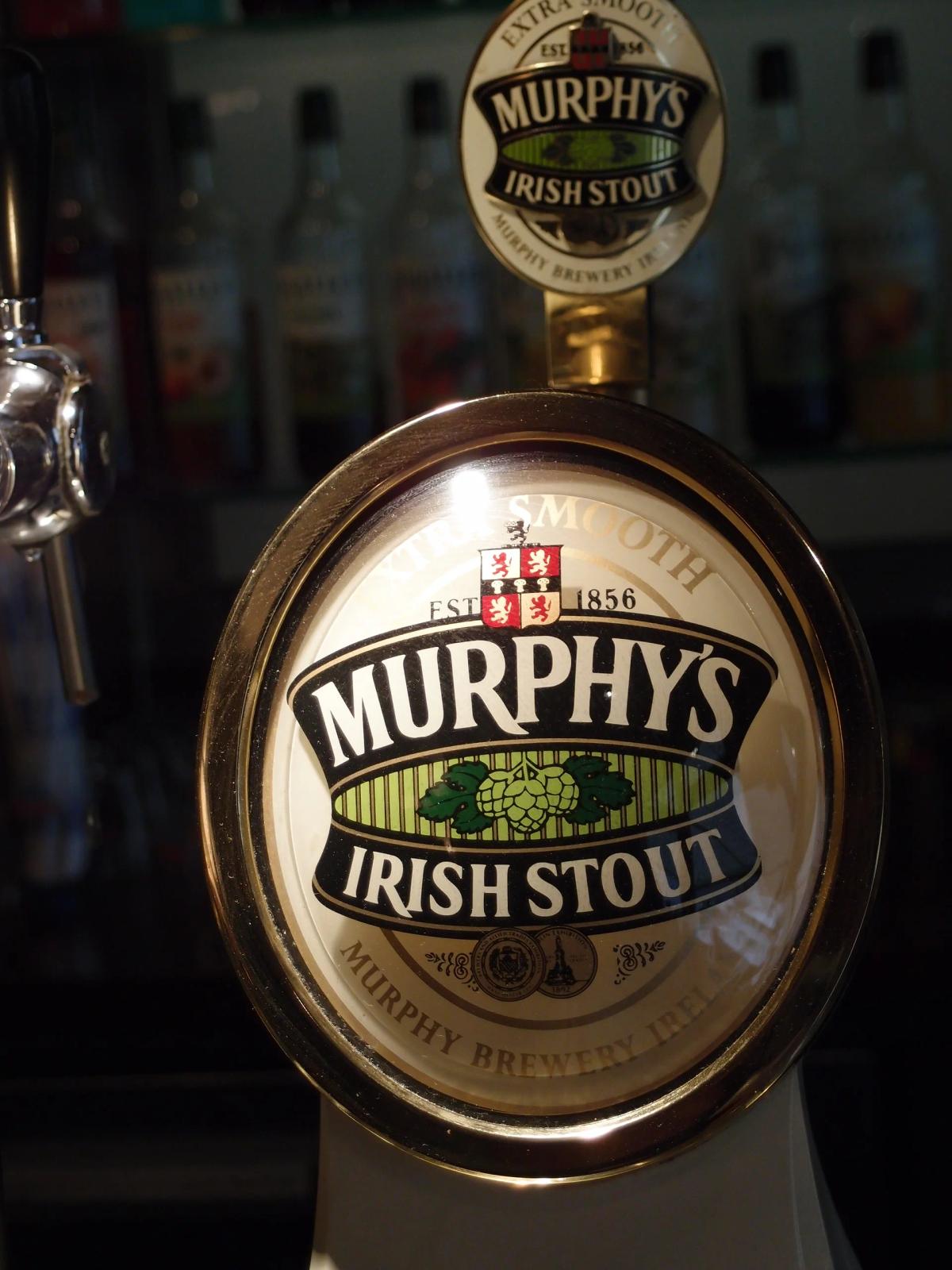
Murphy’s: history, origins and where to enjoy this Irish beer in Barcelona city centre
Talking about Murphy’s means talking about one of Cork’s great brewing names and one of those brands that helps explain why Ireland still carries such weight in pub culture. While Guinness often dominates the international conversation around Irish beer, the truth is that Murphy’s Irish Stout has built a character of its own through its creamy texture, softer profile and a history deeply rooted in southern Ireland.
For a venue such as My Bar, an Irish pub in Barcelona city centre where pints, football and pub culture are all part of the experience, Murphy’s feels like a natural fit. Not only because of its Irish origin, but because it represents a very particular way of drinking beer: slowly, socially, and in a manner closely tied to the ritual of the bar. On the My Bar drinks menu, Murphy’s appears among the Irish draught options, turning this article into more than a piece of beer history. It also becomes a natural invitation to discover it in the heart of Barcelona.
The origins of Murphy’s: Cork, family and brewing heritage
The story of Murphy’s begins in Cork, one of the most important cities in Ireland for understanding the country’s brewing tradition. According to the official Murphy’s Stout website, the brand has stayed true to its Cork roots since 1856, the year the Murphy brothers founded the brewery. The official timeline explains that James J. Murphy and his brothers launched James J. Murphy & Co. in that year, creating a business that would eventually become one of southern Ireland’s best-known brewing names.
The location of the brewery is part of the story too. The official history says that in 1854 the Murphy brothers bought the buildings of Cork’s former foundling hospital and built the brewery there. In time it became known as Lady’s Well Brewery, a name linked to a nearby well of local historical significance. That geographical connection matters: Murphy’s was born in a very specific place and in a very specific local culture, something that still shapes the way the brand is understood today.
The Cork City Council also highlights this origin and notes that Murphy’s Brewery was founded in Cork in 1856 by one of the city’s merchant families. It reminds us that Cork had already become an important brewing centre by the late eighteenth century. In that sense, Murphy’s did not appear in isolation. It emerged as one of the strongest expressions of Cork’s local brewing culture.
When was Murphy’s Irish Stout first brewed?
It is worth being precise here, because the founding of the brewery and the appearance of its most iconic stout are not exactly the same thing. The Cork City Council states that Murphy’s was first brewed in May 1889. That date is especially useful because it places the birth of the stout at a time when the brewery was modernising and expanding. The official Murphy’s timeline also highlights the construction of a new malt house in 1889, a sign of technical and industrial growth.
This allows the story to be told properly: the Murphy company dates from 1856, but the Murphy’s Irish Stout most people recognise today took shape clearly towards the end of the nineteenth century. It is a stout born in Cork, tied to a family brewery and to a period of industrial development.
What kind of beer is Murphy’s?
Murphy’s is most closely associated with its Irish Stout, a dark Irish beer with a dry style, creamy mouthfeel and a relatively gentle profile compared with more aggressively roasted or bitter stouts. The official Murphy’s site describes it as “simple, smooth, natural”, with toffee and coffee undertones, very little harsh bitterness and a creamy finish.
That description matches the way many drinkers experience it: an approachable stout, easy to enjoy and especially suitable for people who want to explore Irish dark beer without beginning with something too intense. The brand itself repeatedly underlines that texture and creaminess are central to the Murphy’s experience.
That said, Murphy’s is not only one product name. In some markets, the brand has also included Murphy’s Irish Red, and on the My Bar drinks menu, Murphy’s appears as an Irish draught beer with a smooth, fruity and refreshing profile. This matters because it links the wider heritage of the brand with the way customers can actually encounter Murphy’s at the bar today.
Murphy’s ingredients
When talking about the classic stout, the clearest information comes from two complementary sources. On one hand, the official Murphy’s website says it is brewed with natural ingredients and explicitly mentions water, malted barley, barley and hops. On the other hand, the environmental report published by Heineken Ireland, relating to the Murphy Brewery site in Cork, lists the ingredients for Murphy’s Irish Stout as malted barley, roasted barley, hops, yeast and water.
That combination explains much of the beer’s profile. The roasted barley contributes its dark colour and roasted character. The malt provides roundness and cereal depth. The hops bring balance without taking over the flavour, while the gas and nitrogen mix helps create the creamy texture associated with the draught serve.
The official brand also emphasises toffee and coffee notes, so from a sensory point of view Murphy’s can be described as creamy, gently sweet, roasted and only moderately bitter.
How is Murphy’s brewed and served?
The technical report from Heineken Ireland outlines a classic brewing process: milling the grains, mashing with hot water, extracting sugars, boiling the wort with hops, cooling it, fermenting it with yeast and then adjusting carbon dioxide and nitrogen levels before the beer is filled into kegs.
For this type of stout, nitrogen plays a very important role in the final experience. The official Murphy’s site recommends serving it chilled and pouring it with the glass held at 45 degrees, allowing the dense, fine foam to form before topping it up after a short settling period. This serving ritual explains much of the visual appeal of the pint and a great deal of its silky mouthfeel.
That detail matters in a setting such as an Irish pub in Barcelona city centre. Part of the pleasure of ordering a Murphy’s does not come only from the beer itself, but from the way it is poured, the way it settles in the glass and the way the tight creamy head finishes the pint. It is one of those beers whose service is part of the story.
Curiosities and iconic moments in Murphy’s history
Murphy’s has a rich history filled with memorable episodes, many of them documented in its own official timeline. One of the most significant involves its early awards. The brand highlights that in 1892 its stout won a gold medal at the Brewers and Allied Trades Exhibition in Dublin, and that it won the top award again when the exhibition was held in Manchester in 1895. Those medals still appear on Murphy’s packaging today, making them a lasting part of the brand’s visual identity.
Another remarkable episode came in 1893, when the famous strongman Eugen Sandow publicly endorsed Murphy’s. The official timeline explains that the well-known image of Sandow lifting a horse became associated with the brand as a symbol of strength and prestige. From a branding point of view, it was one of the earliest major communication moments in Murphy’s history.
There are also more unusual stories, such as the one from 1913, when one of the brewery vats burst and flooded the brewery and Leitrim Street with porter. The official account says that one worker had to swim through beer to avoid suffocation. It is an extraordinary anecdote and exactly the kind of episode that gives a historic beer brand a more human and memorable dimension.
In 1915, Murphy’s purchased the first petrol lorry in Ireland, another sign of its modern outlook. In 1921, the company opened its own bottling plant. In 1994, the brand became visible in sport through its sponsorship of the Murphy’s Irish Open Golf Championship, a partnership the brand still recalls as one of its major moments outside pure brewing.
More recently, Murphy’s has continued to collect quality recognition. The official timeline points to further gold medals in the 2000s, while Drinks Industry Ireland covered a Monde Selection Gold Award for Murphy’s as the only Irish stout recognised by the panel that year.
Murphy’s and its international expansion
Although Murphy’s spent many years as a stout strongly associated with Cork and its local market, the brand made an important move outward in the late twentieth century. The official US site states that in 1979 Murphy’s reached the United States for the first time, reconnecting with emigrant Irish drinkers and reaching a new generation of stout consumers. Later, in 1985, the brand presents that moment as Murphy’s full launch as a national and international name, with exports to the UK, US and Canada.
The Cork City Council also notes that in 1983 Heineken International acquired the assets of Murphy Brewery. That acquisition marked a new phase for the brewery and clearly helped its wider distribution and visibility abroad.
When did Murphy’s arrive in Spain?
There is no single public source that gives a completely precise first-launch date for Murphy’s in Spain. The most accurate statement is that its presence in the Spanish market is documented at least by 2002. That year, Cinco Días reported on Heineken’s Beer Station venues in Spain and stated that among the international brands served there was Murphy Irish Red.
This means there is documentary evidence of Murphy’s in Spain in the early 2000s through Heineken’s hospitality channels. Today, the brand remains part of Heineken’s wider beer ecosystem in Spain and can still be found in selected bars and pubs, including My Bar.
What is Murphy’s traditionally enjoyed with?
In Ireland, a creamy stout has traditionally been associated with robust flavours and, famously, with shellfish. One of the classic pairings in Irish food culture is stout with oysters. The official tourism platform Ireland.com explains that Irish oysters are enjoyed with chilled white wine or with a creamy black stout, placing this pairing firmly within the pub and restaurant culture of the island.
Beyond that classic match, a stout such as Murphy’s also works extremely well with hot pub dishes, fried food and savoury recipes with roasted or meaty depth. Its creaminess and roasted notes make it a natural fit for dishes with a little weight and texture.
How Murphy’s fits naturally into the My Bar menu
This is where the article connects directly with the real experience at the venue. On the My Bar drinks menu, Murphy’s appears as an Irish-origin draught beer with a smooth and fruity profile, and it is also available as a half pint. It sits alongside other international beers within a menu designed for groups, relaxed afternoons and live sport.
If we think about what to order with a Murphy’s in Barcelona city centre, the most natural link is with dishes designed for sharing and staying longer at the table. The My Bar menu includes patatas bravas, Iberian ham croquettes, mozzarella sticks, nachos, homemade burgers and fish & chips. All of that works well with an Irish draught beer because it matches the rhythm of pub drinking: pint in hand, food to share and a laid-back atmosphere.
During terrace season, Murphy’s also makes perfect sense as part of an after-work plan in Barcelona city centre, an afternoon in the Gothic Quarter or a pre-match drink in an Irish pub near Plaça Reial. That is where the article gains real search intent: it is not only about beer history, but about connecting the product with a genuine consumption moment in the city.
Murphy’s today: a pint with history in Barcelona city centre
Murphy’s has gone from being a distinctly local Cork stout to becoming a recognisable name in the international map of Irish beers. Its history combines family tradition, industrial evolution, awards, memorable stories and a style of beer that still finds its audience among drinkers looking for a creamy dark pint with personality.
At a time when many people in Barcelona are looking for more authentic bar experiences, more rooted in real pub atmosphere and less anonymous than generic central venues, a beer such as Murphy’s fits perfectly into the logic of an Irish pub in Barcelona city centre. It has origin, it has story, it has texture and it has a serving ritual that turns the pint into something a little more memorable.
Conclusion
Murphy’s is not just another Irish beer. It is a brand born in Cork in 1856, with an iconic stout first brewed in 1889, a history shaped by the tradition of Lady’s Well Brewery, international awards and a very distinctive way of understanding the dark pint: smooth, creamy and gentler in balance than many other stouts.
If you want to discover it in a setting that genuinely suits it, you can do so at My Bar, right in the centre of Barcelona. There, Murphy’s is part of a drinks menu designed to be enjoyed slowly, with good company and with dishes that suit the pub experience. If you fancy trying it, you can explore the drinks menu, discover the atmosphere of My Bar Irish Pub or head to Carrer Ferran, 8, and order your next pint.
Sources consulted
- Murphy’s Stout – official website
- Cork City Council – Heineken Ireland (Murphy’s Brewery)
- Heineken Ireland AER 2011 – process and ingredients
- Drinks Industry Ireland – Murphy’s quality award
- Cinco Días – Murphy’s in Spain in 2002
- Ireland.com – oysters and stout in Ireland
- My Bar – drinks menu
- My Bar – Irish Pub and Sports Bar